How AR Reduces Returns and Boosts Footwear Sales
How AR Reduces Returns and Boosts Footwear Sales.
A continuation of the first article, where we explored the rise of AR in footwear retail, how it works at a basic level, and the immediate benefits it provides to online retailers. In this second part, we will delve into the steps needed to implement it successfully, real-world examples, and the future that awaits this technology.
Key considerations for implementing an AR virtual try-on
Before diving into AR adoption, online footwear retailers must carefully plan their implementation. A rushed or poorly executed launch can cause technical failures, customer frustration, and a waste of resources.
- Choose the right technology partner: It is essential to choose a partner with extensive experience in AR solutions for footwear, who masters the creation of high-quality 3D models and designs solid, easy-to-use interfaces. Companies like Visualife, in collaboration with ShopAR, specialise in delivering cutting-edge AR solutions.
Choose the right technology partner: It is essential to choose a partner with extensive experience in AR solutions for footwear, who masters the creation of high-quality 3D models and designs solid, easy-to-use interfaces. Companies like Visualife, in collaboration with ShopAR, specialise in delivering cutting-edge AR solutions.
- Optimise for mobile devices: Since most online footwear purchases are made from mobile devices, the AR solution must be perfectly optimised for different screens, operating systems, and camera specifications. Make sure your development team tests the application on both iOS and Android.
Optimise for mobile devices: Since most online footwear purchases are made from mobile devices, the AR solution must be perfectly optimised for different screens, operating systems, and camera specifications. Make sure your development team tests the application on both iOS and Android.
- Maintain and update footwear models: Footwear is a seasonal product and styles change frequently. Keeping the 3D model library up to date is essential to always offer the latest releases.
Maintain and update footwear models: Footwear is a seasonal product and styles change frequently. Keeping the 3D model library up to date is essential to always offer the latest releases.
- Encourage user adoption: Having an excellent AR feature is of little use if customers do not know it exists or do not understand how to use it. Highlight your virtual try-on on product pages, social media, and newsletters. Offer short guides or tutorials to familiarise users.
Encourage user adoption: Having an excellent AR feature is of little use if customers do not know it exists or do not understand how to use it. Highlight your virtual try-on on product pages, social media, and newsletters. Offer short guides or tutorials to familiarise users.
The role of user experience (UX) and design
Although AR is powerful, it depends heavily on the surrounding user experience. An unintuitive interface or confusing navigation can discourage shoppers from using the technology. To ensure the best experience:
- Intuitive onboarding: First impressions matter. A brief pop-up or tutorial on camera and foot placement can reduce friction and deliver a more accurate virtual try-on.
Intuitive onboarding: First impressions matter. A brief pop-up or tutorial on camera and foot placement can reduce friction and deliver a more accurate virtual try-on.
- Seamless integration: The AR feature should feel like a natural extension of your e-commerce platform, making it easy to switch between AR, product details, and checkout.
Seamless integration: The AR feature should feel like a natural extension of your e-commerce platform, making it easy to switch between AR, product details, and checkout.
- Visual cues and feedback: Including guides on correct foot placement, real-time error messages, and helpful suggestions keeps customers engaged.
Visual cues and feedback: Including guides on correct foot placement, real-time error messages, and helpful suggestions keeps customers engaged.
- Optimised performance: A virtual try-on runs on real-time renderings. Efficient code and compression must be used to ensure a smooth, lag-free experience.
Optimised performance: A virtual try-on runs on real-time renderings. Efficient code and compression must be used to ensure a smooth, lag-free experience.
Real-world success stories
Some well-known footwear brands have already seen the benefits of AR:
- Nike: Has experimented with virtual try-ons for certain sneaker launches, allowing fans to see how they look before buying. They generate anticipation and obtain valuable data on user preferences.
Nike: Has experimented with virtual try-ons for certain sneaker launches, allowing fans to see how they look before buying. They generate anticipation and obtain valuable data on user preferences.
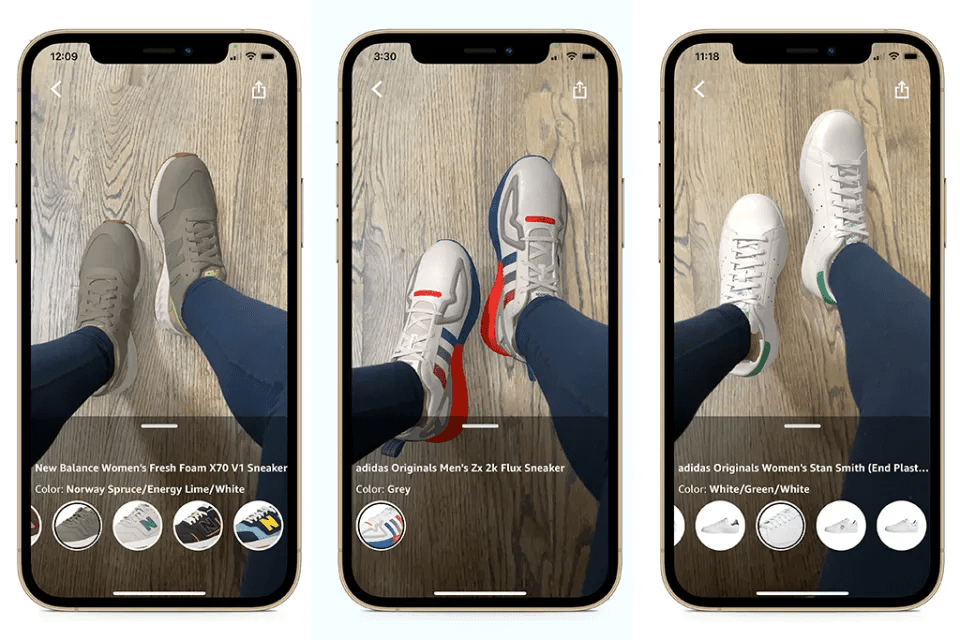
- Adidas: Has collaborated with AR technology partners to develop a complete virtual try-on. Its intuitive interface offers multi-angle views and customisation options, increasing time on site and conversion for models that incorporate AR.
Adidas: Has collaborated with AR technology partners to develop a complete virtual try-on. Its intuitive interface offers multi-angle views and customisation options, increasing time on site and conversion for models that incorporate AR.
- E-commerce players (Amazon, Zalando, etc.): Have run pilot projects with virtual try-ons for footwear with the aim of reducing return rates and differentiating themselves in an increasingly saturated market.
E-commerce players (Amazon, Zalando, etc.): Have run pilot projects with virtual try-ons for footwear with the aim of reducing return rates and differentiating themselves in an increasingly saturated market.
These examples highlight the power of AR to generate consumer excitement, brand loyalty, and increased sales.
The future of AR in footwear retail
As smartphone technology continues to advance and consumers become increasingly accustomed to AR, it is reasonable to expect that virtual try-ons will become a standard. Upcoming phases of AR could include:
- Advanced foot scanning: Beyond simple overlays, in the future AR could measure highly precise foot dimensions and suggest exact sizes, further reducing uncertainty.
Advanced foot scanning: Beyond simple overlays, in the future AR could measure highly precise foot dimensions and suggest exact sizes, further reducing uncertainty.
- Haptic feedback and wearables: Emerging technologies such as haptic feedback could add an extra layer of realism. Smart insoles or other devices would collect data on gait, width, and pressure points for more accurate recommendations.
Haptic feedback and wearables: Emerging technologies such as haptic feedback could add an extra layer of realism. Smart insoles or other devices would collect data on gait, width, and pressure points for more accurate recommendations.
- Virtual showrooms and metaverse integration: Retailers could create immersive 3D spaces where shoppers try on digital footwear without leaving home. Purchases could even be linked to digital collectibles or NFTs.
Virtual showrooms and metaverse integration: Retailers could create immersive 3D spaces where shoppers try on digital footwear without leaving home. Purchases could even be linked to digital collectibles or NFTs.
- AR applications in physical stores: Imagine pointing your phone at a shoe on a store shelf and seeing reviews, colour variations, or outfit suggestions. This fusion of digital and physical will increase conversion rates and personalisation.
AR applications in physical stores: Imagine pointing your phone at a shoe on a store shelf and seeing reviews, colour variations, or outfit suggestions. This fusion of digital and physical will increase conversion rates and personalisation.
Taking the leap with Visualife
For companies ready to embrace the future of online footwear retail, partnering with the right AR provider is essential. Visualife is at the forefront of augmented reality, offering scalable, easy-to-use solutions designed for footwear brands. By partnering with them, you can:
- Access high-quality 3D modelling: Thanks to the collaboration with ShopAR, the Visualife team creates realistic shoe models that reflect every detail, reinforcing customer trust.
Access high-quality 3D modelling: Thanks to the collaboration with ShopAR, the Visualife team creates realistic shoe models that reflect every detail, reinforcing customer trust.
- Seamless e-commerce integration: Their solutions can integrate with Shopify, WooCommerce, Magento, or other platforms, reducing any friction.
Seamless e-commerce integration: Their solutions can integrate with Shopify, WooCommerce, Magento, or other platforms, reducing any friction.
- Ongoing support and analytics: Visualife provides maintenance and updates, as well as detailed analytics reports on user adoption and preferences.
Ongoing support and analytics: Visualife provides maintenance and updates, as well as detailed analytics reports on user adoption and preferences.
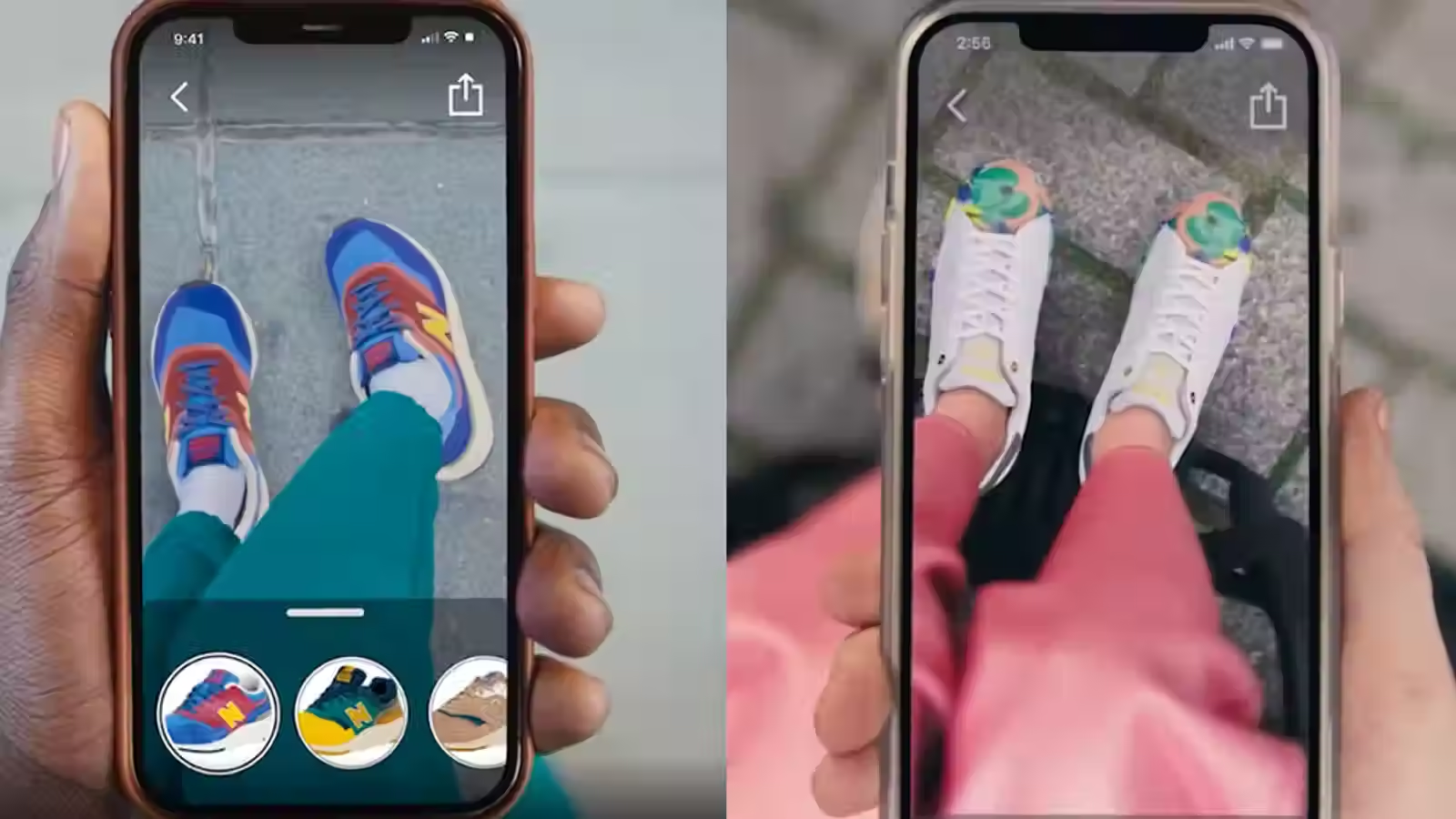
- Custom features: From swapping colours and styles to data-driven recommendations, customisation options adapt to your brand identity.
Custom features: From swapping colours and styles to data-driven recommendations, customisation options adapt to your brand identity.
Conclusion
The footwear industry is undergoing a profound digital transformation, and augmented reality is at the forefront of that change. Offering a virtual try-on experience gives online footwear retailers the opportunity to reduce returns, increase customer engagement, and differentiate themselves in a crowded market.
Far from being a mere gimmick, AR has become an essential tool for delivering a more immersive, satisfying, and interactive shopping experience. Given the continued evolution of mobile technology and the growing acceptance of AR, it is very likely that it will be an essential part of the footwear purchasing process in the near future.
For companies seeking a competitive edge, adopting AR technology early can deliver lasting benefits. From boosting customer loyalty to enabling data-driven personalisation, the potential of AR to optimise online footwear sales is enormous.
By partnering with a leading provider like Visualife, brands can implement augmented reality simply and effectively, positioning themselves as pioneers in the online footwear market.
Ultimately, those who step into the future of AR-driven retail will be better prepared to meet consumer expectations and thrive in a digital environment where immersive, personalised experiences are becoming the norm.